" class="responsive" alt="" />
China leading steelmakers are consolidating to remain competitive during these uncertain times.
Amid a myriad of challenges such as raw material price volatility, shifting demand centers, supply chain disruptions, productivity, and cost-efficiency, against a backdrop of decarbonization steadfastly growing in its prominence, Chinese leading steelmakers are consolidating to remain competitive during these uncertain times.
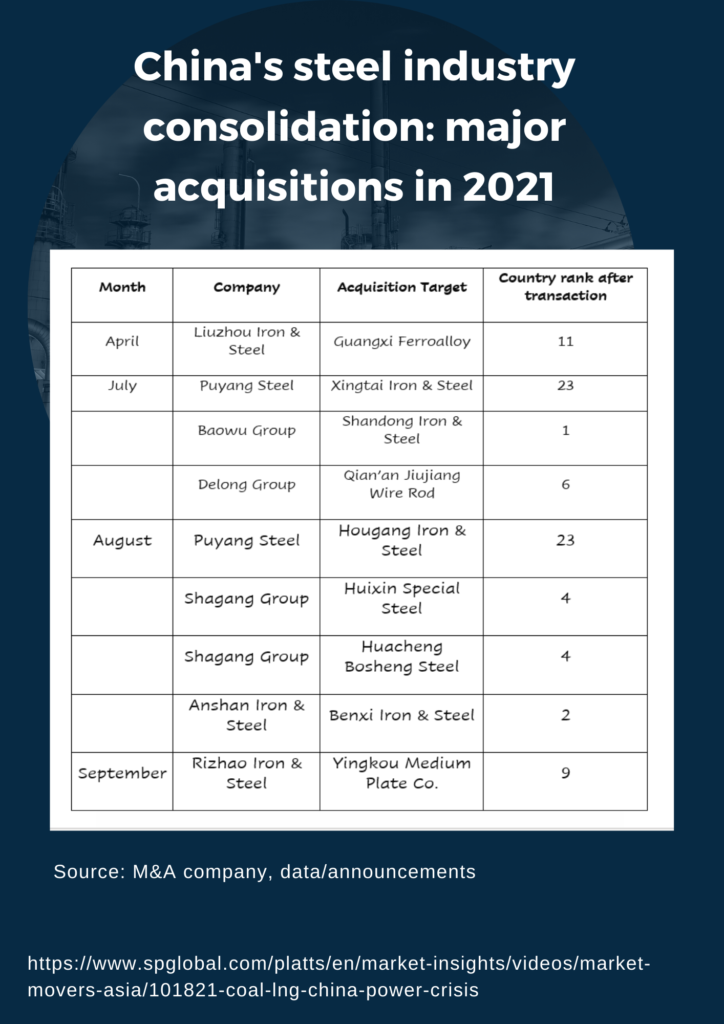
China’s steel industry mergers and acquisitions are gaining pace the last few months. China has set a target to increase the ratio of the top 10 steelmakers’ crude steel output to the country’s total output to 60% by 2025, as it aims to meet its ambitious decarbonization goals.
The accelerated M&A by the leading steelmakers has seen the Chinese steel industry meet multiple targets at once, such as cutting steel production, capping iron ore prices, and reducing carbon emissions. It also gives the country higher negotiating power for raw material prices.
The consolidation is believed to help China’s leading steel mills to raise their market share and improve margins in an increasingly competitive market. Some mill sources said mergers and acquisitions were crucial for all Chinese mills to survive in a highly competitive future, as domestic steel demand had almost plateaued amid slowing economic growth, while the efforts to reduce carbon emissions will keep raising the steelmakers’ environmental protection costs.
In its bid to cap iron ore prices and meet China’s ambitious decarbonization goals, the steel industry needs to consolidate to achieve synergies, some sources added.
China’s steel industry accounts for around 15%-20% of the country’s annual carbon emissions.
China’s steel industry consolidation: major acquisitions in 2021